
There is no one-size-fits-all solution
When one or more teeth are missing, or when existing teeth are severely compromised, there are several paths to restoring function and appearance. The right choice does not depend on which option is "the best" in absolute terms, but on which one best fits your specific clinical situation, your daily needs and your budget. This guide aims to help you understand the main differences, so you can approach the conversation with your dentist with greater confidence.
Dental implant
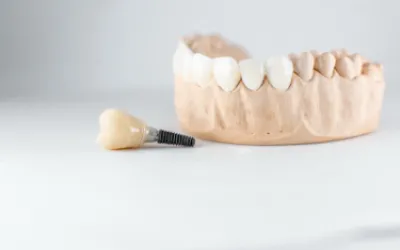
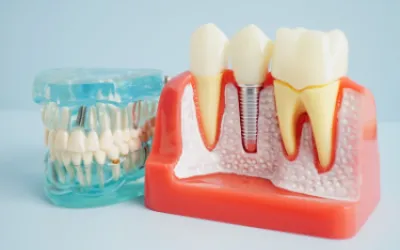
An implant is an artificial titanium root placed in the jawbone, onto which a crown is later fixed.
- Advantages: it is the solution closest to a natural tooth, does not involve neighboring teeth, preserves the bone by stimulating it the way a natural root would, and is designed to last over time with proper maintenance
- To consider: it requires a sufficient amount of bone (or preliminary bone regeneration), longer healing times between placement and final loading, and generally a higher initial investment than other solutions
- Recommended for: those who have lost one or more teeth and want a fixed, long-lasting solution, with generally good bone health
Dental bridge
A bridge is a fixed prosthesis that rests on the natural teeth adjacent to the gap, which are filed down to act as support.
- Advantages: faster turnaround than an implant, no surgery involved, generally lower cost
- To consider: it requires filing down healthy teeth to act as support, and those teeth bear a greater chewing load over time
- Recommended for: those who already need work on adjacent teeth (for example, crowns), or who prefer to avoid surgery
Removable denture (partial or full)
A removable denture is a solution that can replace several missing teeth or an entire dental arch.
- Advantages: the most affordable solution, no surgery required, suitable even for those with significant bone loss
- To consider: it requires an adjustment period, offers less chewing stability than implants or bridges, and needs regular maintenance
- Recommended for: those who have lost many or all their teeth and are looking for an affordable solution, or as a transitional solution before an implant path
Hybrid solutions: the case of full edentulism
For those who have lost all the teeth in an arch, there are also solutions that combine several implants (generally 4-6) with a fixed prosthesis screwed onto them, offering implant-level stability with a limited number of surgical placements. This is an option to evaluate with the dentist based on bone condition and functional expectations.
How to reach the right decision
The final choice should always be based on a complete clinical assessment, including 3D scans and an in-depth conversation with the dentist, in which all the pros and cons of each applicable option for your specific case are clearly explained, along with the related costs. Be wary of anyone who offers you only one solution without explaining the alternatives: a good decision-making process always puts the patient in a position to choose in an informed way, without pressure, carefully weighing the timing, costs and long-term implications of each option.
In our network, every treatment plan is built together with the patient after the diagnostic visit, transparently presenting all available alternatives, so the final decision is always yours, made with all the information you need.